
Last week we covered the dual announcements from OpenAI and Anthropic on their respective JVs—$5.5 billion committed between them, a figure without precedent for a services joint venture.
We concluded with a suggested approach to navigating the discussion at the Board level. The article was very well received. You can read it and other resources here.
Today we turn to transformation—a space we know from both sides. We’ve led it ourselves as operators, serving as Chief Growth Officer, Chief Executive Officer, Head of Transformation, and CIOs. In this article we will use the announcement lay-off at Block to explain different approaches organizations are taking to AI transformation. We use that decision to unpack what makes AI transformation fundamentally different from past disruptions, the behaviors that separate the rare successes from those that fail outright, and the four questions every executive team should be discussing before they start.
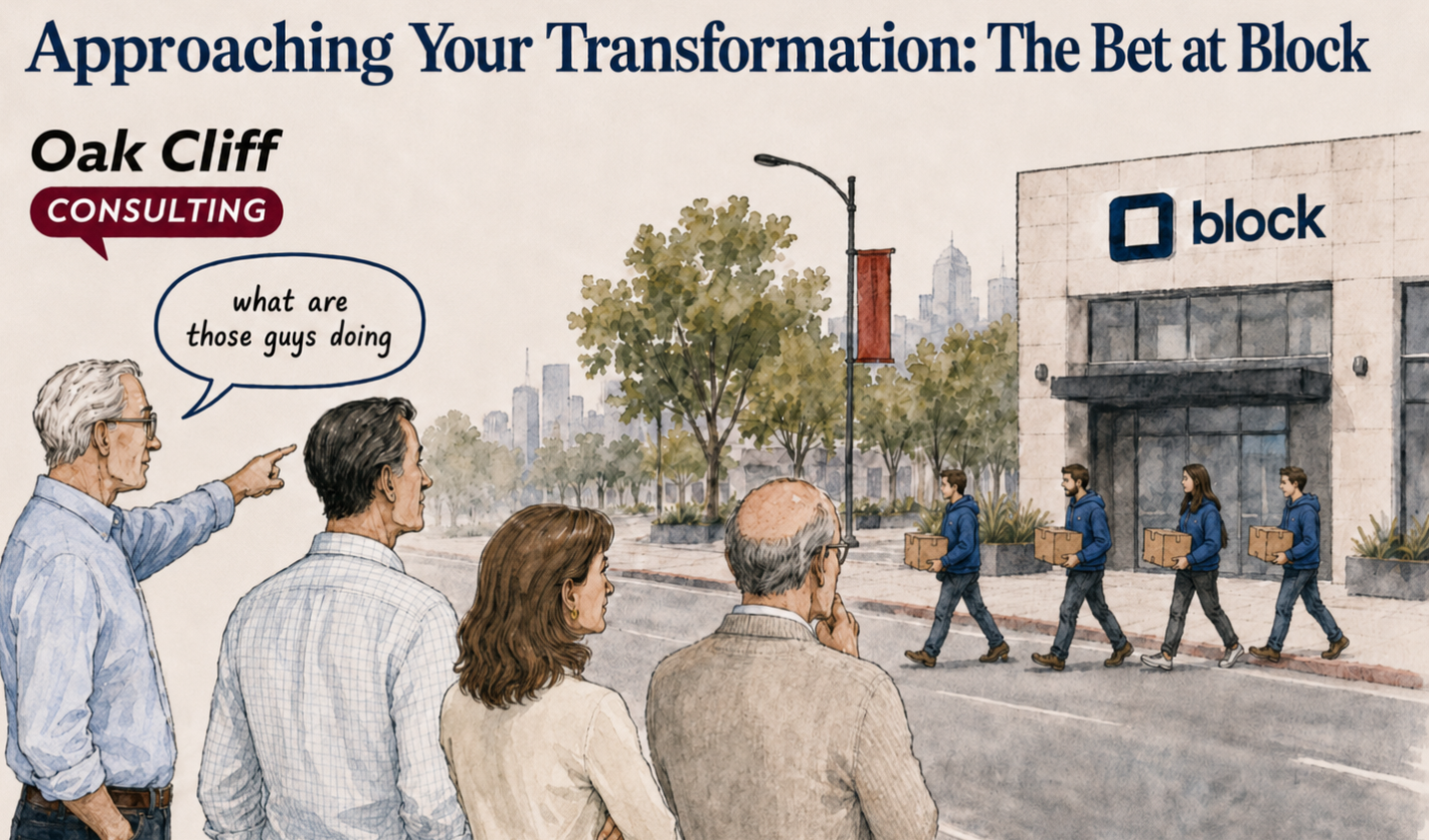
Back in March, Jack Dorsey said Block would cut its workforce by 40 percent, about 4,000 roles, and he pointed directly at fast-improving AI models as the driver.
The contour of a horizon only resolves once the dust in front of you settles. Three months removed from the announcement and now armed with other data on how companies are approaching transformation, we have a better understanding of Block’s decision and how the broader market is approaching AI transformations.
The skeptical camp call Block’s move “AI-washing”—basically a normal restructuring after years of excess hiring, wrapped in trend language. The AI enthusiasts treat it as evidence that the new tools are already changing companies on a real scale. Both interpretations miss the mark.
Redesign first—or remove cost first?
Leaders have a choice in transformation: Do I redesign first, and then remove the cost later? Or do I remove the cost, and then do the redesign work?
The former provides certainty of the landing point before major disruptions to the installed approach. The latter allows a transformation to proceed with a smaller cost base to transform. The latter also allows those remaining post-reduction-in-force workforce to understand that remaining at the company will require a different way of working.
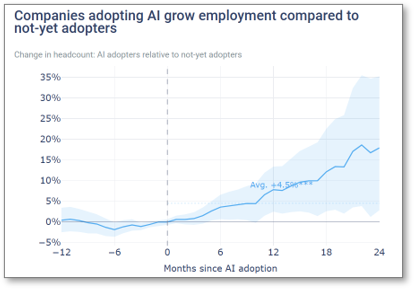
Most organizations seem to be redesigning first before cutting the workforce. The Revelio Labs chart included here tracks average FTE growth for companies adopting AI against a non-adopter baseline set at zero. Adopters are adding headcount faster than non-adopters—a sign of “redesign first, reduce cost later.”
So what is the case for why Dorsey appears to have done the opposite of the current trend? As discussed in our prior article, the return on AI transformations is poor. Is Dorsey that certain in the value of the technology?
We are reminded of the Diary of Henry Jones Sr. in Indiana Jones and the Last Crusade: “Only in the leap from the lion's head will he prove his worth.”
Beyond the promise of the technology, what follows is a strategic discussion of three elements of the current backdrop that we believe pushed Dorsey to act—this transformation is structurally harder than past ones, its scale rewards bigger bets, and transformation success itself remains rare.
AI transformation will be harder than prior disruptions
To be successful in an AI transformation, you need to address both “tech debt” as well as “operating model debt.”
Anyone who has lived through a CRM or ERP migration knows “tech debt.” It’s what piles up when you stitch tools together across mismatched environments because speed matters more than cleanliness.
Like financial debt, tech debt is not inherently bad. Its accumulation is a trade-off you made, and you just hope to be able to navigate the moment when the bill becomes due.
“Operating model debt” is the parallel cost most companies haven’t labeled yet.
Strategy only becomes results through an operating model—the functional resourcing, decision rights, cadence, accountability, and the culture that drive your business. “Operating model debt” is the unaddressed break points—the lack of clarity around decision-making, the broken cross-functional ways of working, the lack of clear processes.
To be successful in AI, you need to address both the tech stack and the operating model. For example, to build a cross-functional agent that handles work currently split across two roles, you need the technical integration into existing systems plus the organizational redesign underneath it: job definitions, workflows, and decision rights.
If you skip that second part, the fuzziness of your operating model limits the return before you ever really get started.
That gap helps explain why something like 95 percent of AI projects get abandoned, why payback often stretches beyond two years, and why even “best case” aggregate ROI lands in low single digits.
The size of the disruption encourages larger bets
Since 1970, average tenure on the S&P 500 has dropped from 33 years to 15. More than half the companies that were on the index in 2000 are gone now. If you set aside plain bad management, the disappearances typically trace back to one of two mechanics: task displacement—the ATM reducing teller demand—or paradigm shift—mobile banking making branches less central. Firms that adjusted to one or the other made it. Firms that failed fell off the index.
AI doesn’t stay neatly in either the “task automation” or “paradigm shift” bucket. AI automates enough tasks inside a single role that it can erase the role itself. And as that automation spreads through adjacent functions, it starts pushing on the business model assumptions underneath the work.
Take Hell Grind, a science-fiction feature that premiered at Cannes this year: 95 minutes, shot in two weeks, made for $500,000 with a team of 15. Conventional estimates put an equivalent film at something like $50 million and three years. You can argue with the comparison, sure, but at that magnitude you’re not debating whether the canyon is big; you’re debating how big.
Transformation successes are rare
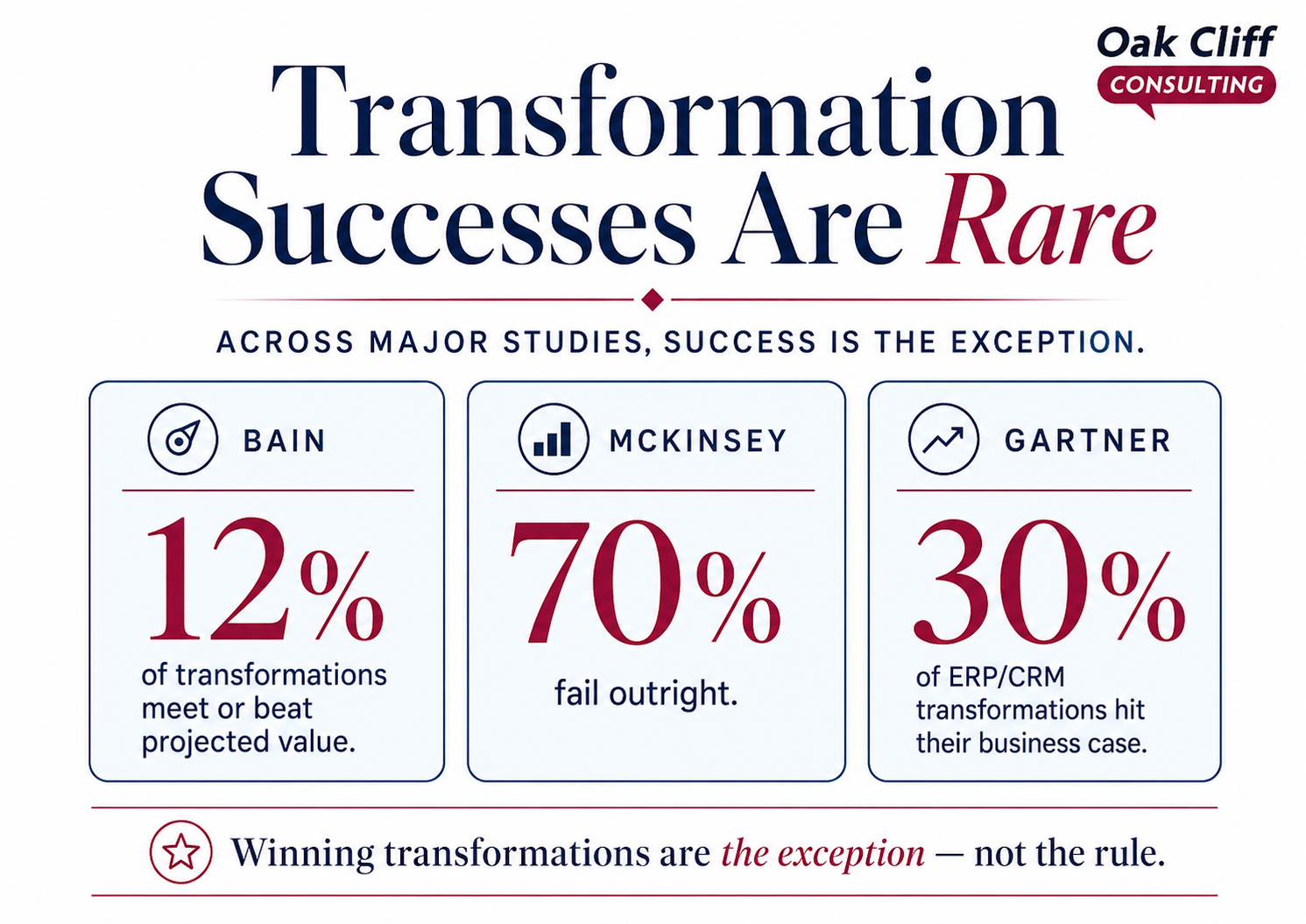
Bain: only 12 percent of transformations meet or beat projected value. McKinsey: 70 percent fail outright. Gartner: just 30 percent of ERP/CRM transformations hit their business case. Transformation success is the exception—and our experience points to three behaviors that show up in the exceptions.
The last in-house transformation I (Andrew) led, as Chief Growth Officer, started in a hole: fourth-quartile engagement, enrollment down 80 percent, rising cost to serve. By the end: engagement hit the second quartile, enrollment topped the prior record by 100 percent, cost to serve normalized, and operations grew from 5 states to 31.
To create this level of transformational change, the CEO, the CFO, and myself focused our attention in three areas.
1. Bring the Board and Executive team with you
CEO included: “I have endless appetite to hear your concerns, but I’ll also tell you why this is the right course.” The CFO and I echoed that. We painted the future, answered hard questions, and built confidence right when it could have cracked. Successful transformations require leadership, a clear vision from the top, clarity, and transparent communication.
2. Empower middle management
Reluctant staff got a clean off-ramp; those who stayed led future-state design through initiatives, reporting to the Executive team fortnightly. Change starts top-down from senior leadership, but it is sustained middle management-out.
3. Speed up decision-making
A small, trusted group owned the detailed build, guided by one filter: answer quality weighed against time and effort. Most decisions were treated as reversible. Time is not your friend in a transformation—speed, momentum, and action are.
How seriously did the CEO take this? He laminated the 12% transformation success rate—and hung it in his window as a constant reminder.
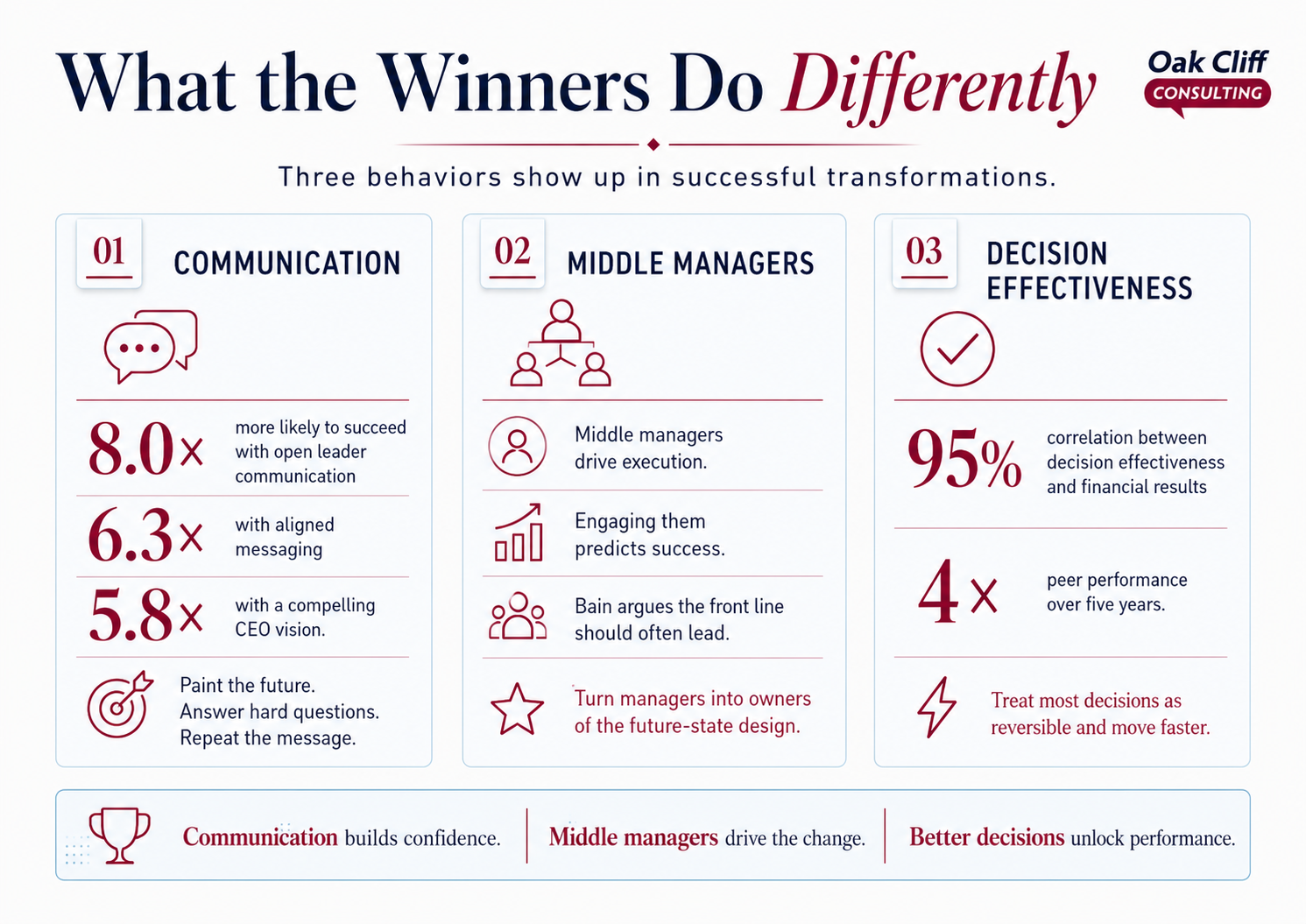
These three focus areas track with Bain and McKinsey’s data:
- Communication: McKinsey found transformations are 8.0x more likely to succeed with open leader communication, 6.3x with aligned messaging, and 5.8x with a compelling CEO vision.
- Middle managers drive execution: Engaging them predicts success; Bain argues the front line should often lead.
- Decision effectiveness: Correlates 95% with financial results, returning 4x peer performance over five years.
For any transformation to be successful, we believe all three of these focus areas need to be present—and this will be true for Dorsey and Block. Effectively doing the above is hard, and complexity increases with a larger workforce. For Block, operating with materially fewer FTEs at the start of the transformation is a bet to tip the scales in favor of transformation success.
Will Dorsey and Block’s approach prove to be the better one? “Truth is the daughter of time, not of authority,” Francis Bacon wrote—and time hasn’t rendered its verdict yet. What we can offer now isn’t an answer, but the questions every executive team should be asking before they place their own bet.
Executive Discussion Rubric
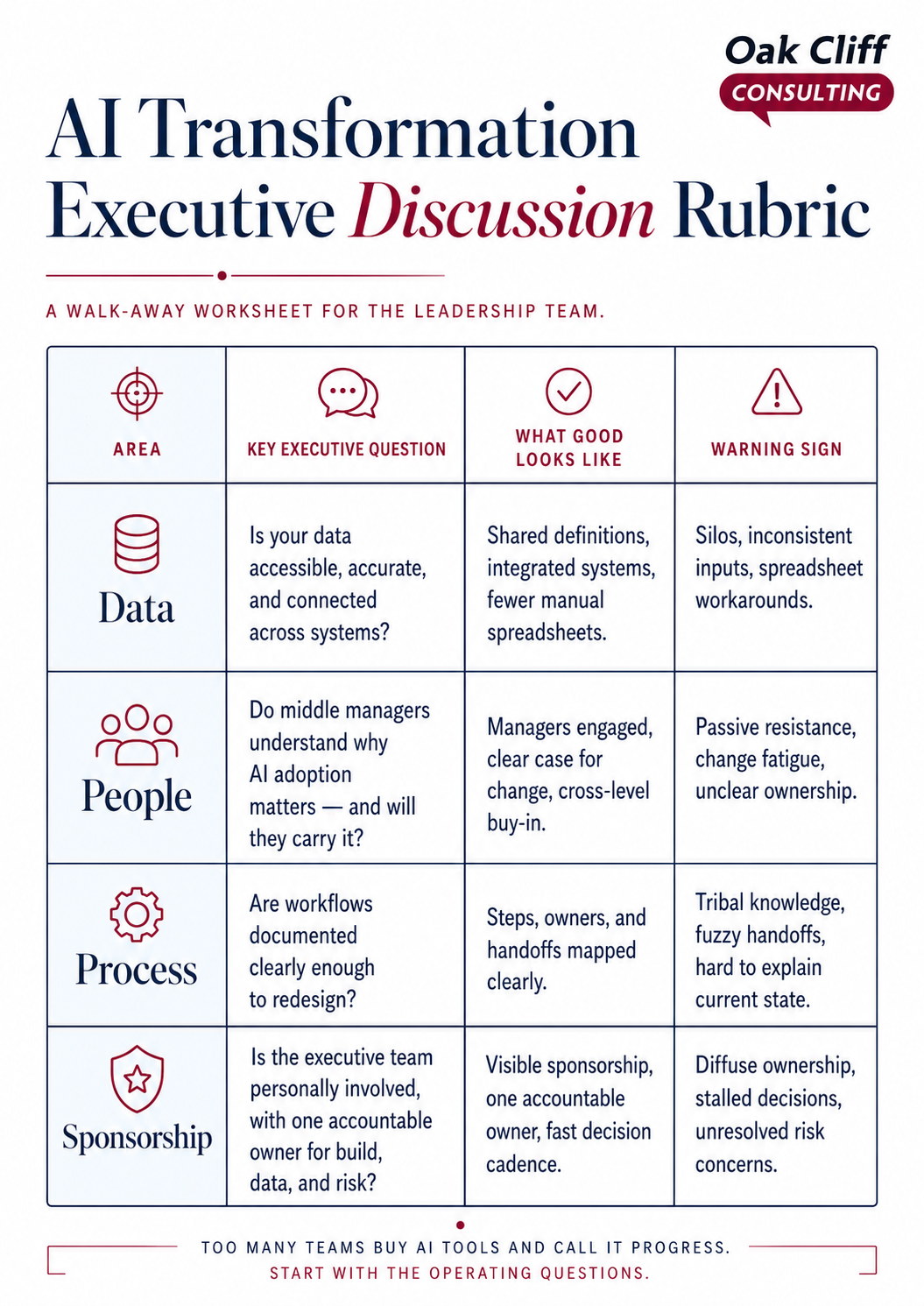
Starting your AI transformation? Here are four executive-level questions that you should be discussing to understand the potential scope of change that is necessary to be successful:
Data
Is your data accessible, accurate, and connected across systems, or stuck in silos and spreadsheets? Does leadership, the board, and the frontline agree on the key metrics and how they are determined? AI running on inconsistent inputs doesn’t sharpen decisions; it muddies them.
People
Do your middle managers understand why AI adoption matters, and will they carry it? Transformation doesn’t run purely top-down or purely middle-out. It needs both, at once.
Process
Are workflows documented clearly enough to redesign? AI can’t improve an inconsistent process or one you can’t explain.
Sponsorship
Is the executive team personally involved, and is there one accountable owner for what gets built, what data it touches, and what level of risk is acceptable? Without both, things stall.
For all incumbents, the requirements for success stay fixed. The path you take depends on how you answer those four questions. Too many organizations dodge them.
That avoidance is part of why teams switch on Copilot, buy a pile of Claude seats, and report “experimentation” to the Board—activity that can build fluency at the edges yet rarely ties cleanly to a financial or operational outcome.
Need help running the diagnostic?
We’ve done it before. Tell us what you are working through and we will give you a direct answer.
Ask Oak CliffAbout Oak Cliff Consulting
Oak Cliff Consulting was founded in 2026 through a partnership between former middle-market executives and former members of Bain’s leadership team. Together, we’ve served as CEOs, CGOs, and CIOs, and we’re trusted by clients across the world as advisors and counselors.
