
Oak Cliff Consulting launched in 2026, founded by former middle-market executives and former Bain leadership. We have run companies as CEOs, CGOs, and CIOs, and clients worldwide rely on us as advisors and counselors. Our mission: help companies transform their operating models — to prepare for AI, execute an integration, or reinvent a struggling core.
This article marks the third installment in a four-part series built to help board members and executives navigate the uncertainty surrounding AI transformation. Our first article mapped the $5.5 billion collision between the Anthropic and OpenAI deployment ventures, untangled a landscape where ROIs run negative yet the investment imperative remains real, and offered a rubric for board discussions about the scope of your AI ambition. Our second article used Jack Dorsey's cut-first decision at Block to show how "tech debt" and "operating model debt" stall AI transformations — operating model debt meaning the unaddressed decision rights, broken cross-functional workflows, and unclear accountabilities that block AI's upside. Both articles can be found here.
Today we will start by looking at the ‘repricing’ fears that owners and operators should have. We believe the fears are warranted beyond just the industries already re-priced. Next, we will dig deeper into operating model debt and examine a specific company, a specific cost structure, and a specific moat — and use them to show how native-AI companies could upend the industry, and what incumbents must do now to respond. Our point-of-view: AI is more than a technology problem – it is changing how companies execute the work. Incumbents ignore this at their own peril, opening themselves up to disruption from AI-native upstarts.
The Concern: Broad Industry Repricing
This week, Ford re-hired the R&D team it laid off. State Farm is rethinking parts of its AI platform and broader transformation. A fair question follows: if ROI runs flat to negative, and large incumbents are unwinding their AI investments, why should we invest at all?
Because AI-native companies threaten to enter your space, erode long-standing strategic moats, and force a re-pricing of the value you deliver to customers.
Re-pricing strikes fast and hard. Wall Street Journal readers likely caught the piece on private equity's nine-year backlog (see here) — the 1,200 software companies bought in the 2020–2021 binge that remain on the books because of the "SaaS-pocalypse," the fear that AI-native products can replace, compress, or reprice large chunks of traditional SaaS functionality. Since the start of 2024, the software ETF trails the S&P 500 by roughly 46 points. S&P Global reported in March that 15% of software debt trades below $0.85 on the dollar. Most of that re-pricing hit within a six-month window starting in late 2025.
We won't predict the timing or magnitude of re-pricing in other sectors — that exceeds the reach of our magic eight ball. Instead, let's examine a sector we would have called "safe" from broad re-pricing just 24 months ago: commercial products and services.
The Test: AI-Native Disruption in Commercial Products & Services
For context, commercial services — B2B companies that help other organizations operate, sell, comply, maintain facilities, manage people, or outsource non-core work — accounted for roughly 30% of 2025 deal count, according to PitchBook. Most of these acquisitions bolted onto pre-existing platform plays, and average deal sizes never approached SaaS levels of 2020–2021. But the sheer volume of commercial products and services acquisitions means a re-pricing of this sector would devastate most funds.
The threat: AI-native operating companies acquire fragmented services businesses, then deploy AI to change the economics of the underlying work. Currently, General Catalyst and Thrive Capital lead this charge with $2B+ raised behind this thesis.
“Your margin is my opportunity” – Bezos aphorism.
To understand what this looks like, let's examine how a specific company in commercial products and services could be attacked. Our example company is Valtir. For disclosure, Valtir is not a client and we have no relationships with their management or ownership team. All information available about them is based on public sources, or assumptions we are making based on experience.
Examining the Threat of Disruption: Valtir
Valtir sells the full highway-safety catalog — guardrails, end terminals, crash cushions, barriers, attenuators, barricades, sign supports, delineators. The company operates 14 manufacturing and rental/distribution facilities plus a distributor network, serving contractors, distributors, and government agencies across North America. Founded in the late 1960s; acquired by private equity in the early 2020s.
Assuming Valtir's cost bar resembles peers', roughly 40% of revenue goes to materials and selling expense, 15% to direct labor and plant overhead, 5% to freight, and 20% to SG&A — leaving roughly 20% EBITDA margins. Assuming 500 FTEs (based on a rounded-up LinkedIn count), headcount likely breaks down to 200 in manufacturing, 75 in supply chain, 100 in sales, 50 in engineering, 25 in branch operations, and 50 in corporate.
Two national competitors trail Valtir on reach and product breadth. Beyond those three players, the market fragments by product and region.
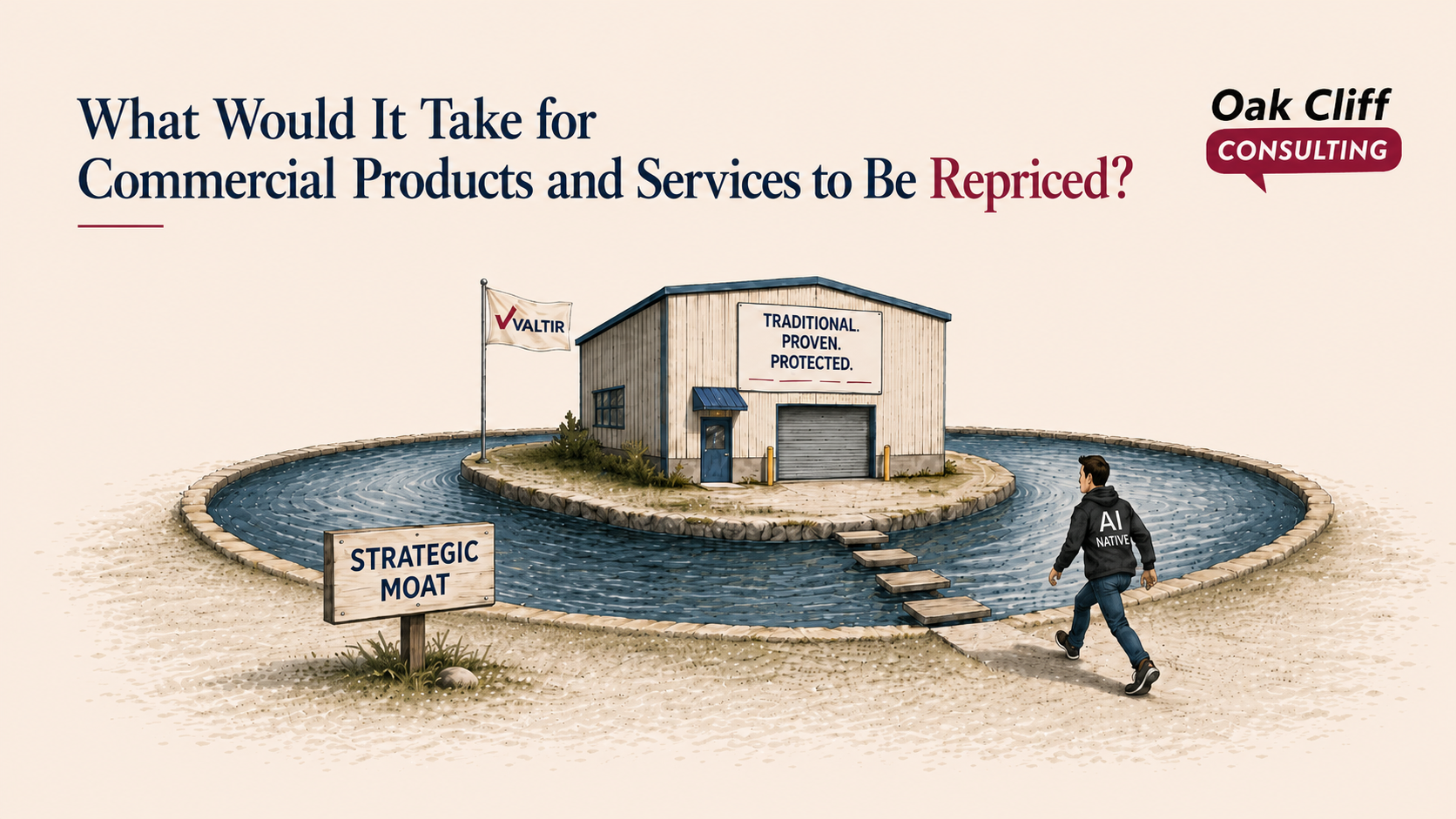
Valtir's strategic moat rests on four pillars: product quality and breadth (products with regulatory approval and one purchase order covers everything), price (vertical integration), availability (14 distribution centers and a national dealer network), and relationships (a 100-person salesforce covering every agency, GC, and sub).
This was the strategic landscape underwritten in the early 2020s: a seemingly safe vehicle that would grow with the economy, generate cash to pay down debt, and deliver returns on financial leverage alone.
“Only the paranoid survive” – Andy Grove.
Now let's stress-test the moat against an AI-native operating model.
How the Moat Gets Eroded
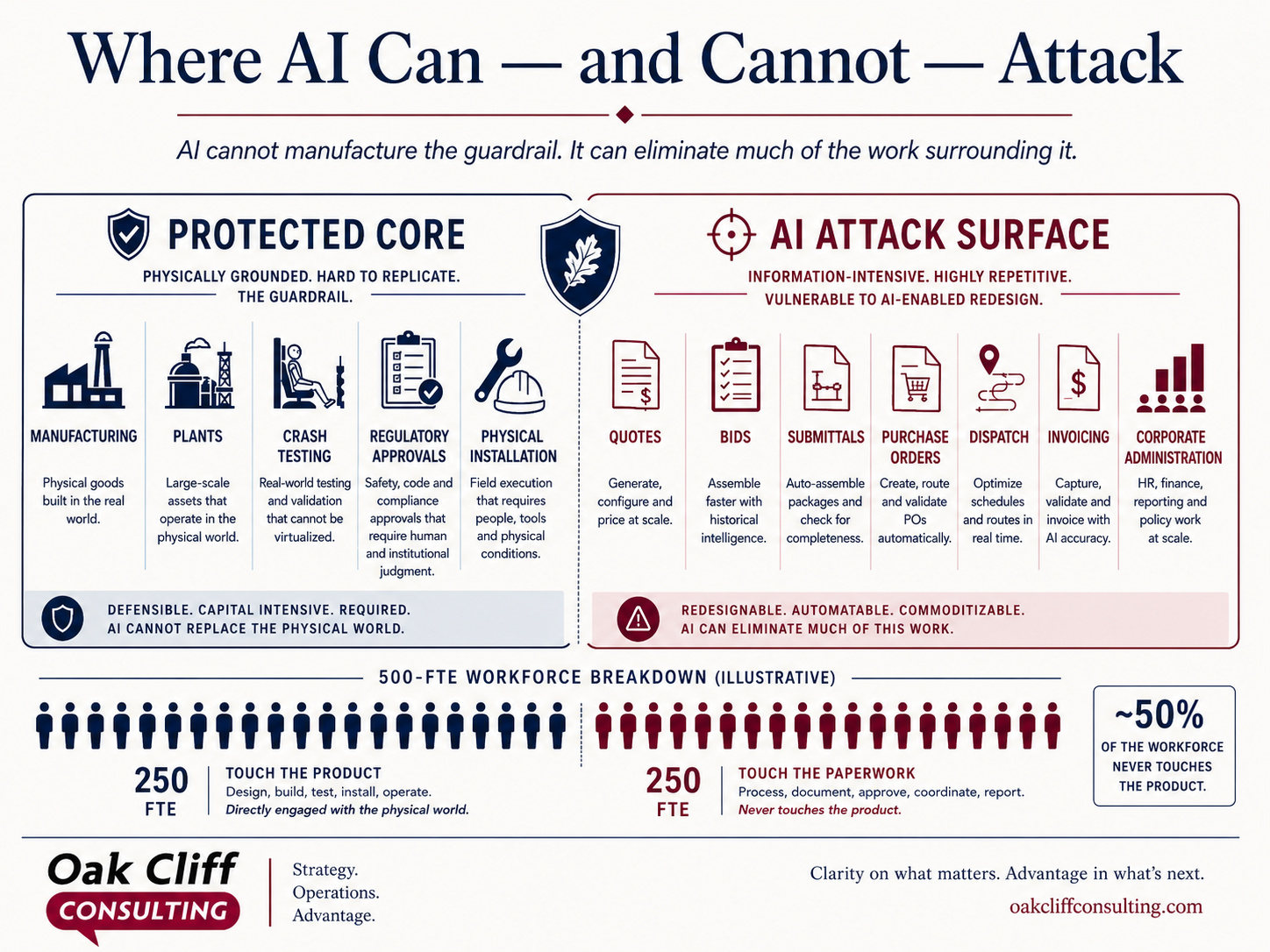
Concede the obvious first: AI cannot pour guardrails. Many of Valtir's products carry crash-test specs and regulatory approvals; the 200 manufacturing FTEs and 14 plants stand as true strategic moats. This makes this industry distinct from software and many ‘white collar’ industries. But while some industries are isolated, none is immune from its impact.
Half of Valtir's FTEs — sales, supply chain, branch operations, corporate — never touch the product. They touch quotes, bids, submittals, purchase orders, dispatch schedules, invoices. That population, and the 20–30 points of SG&A and selling expense behind it, offer the attack surface. Cut them, and three pillars of Valtir's moat crack:
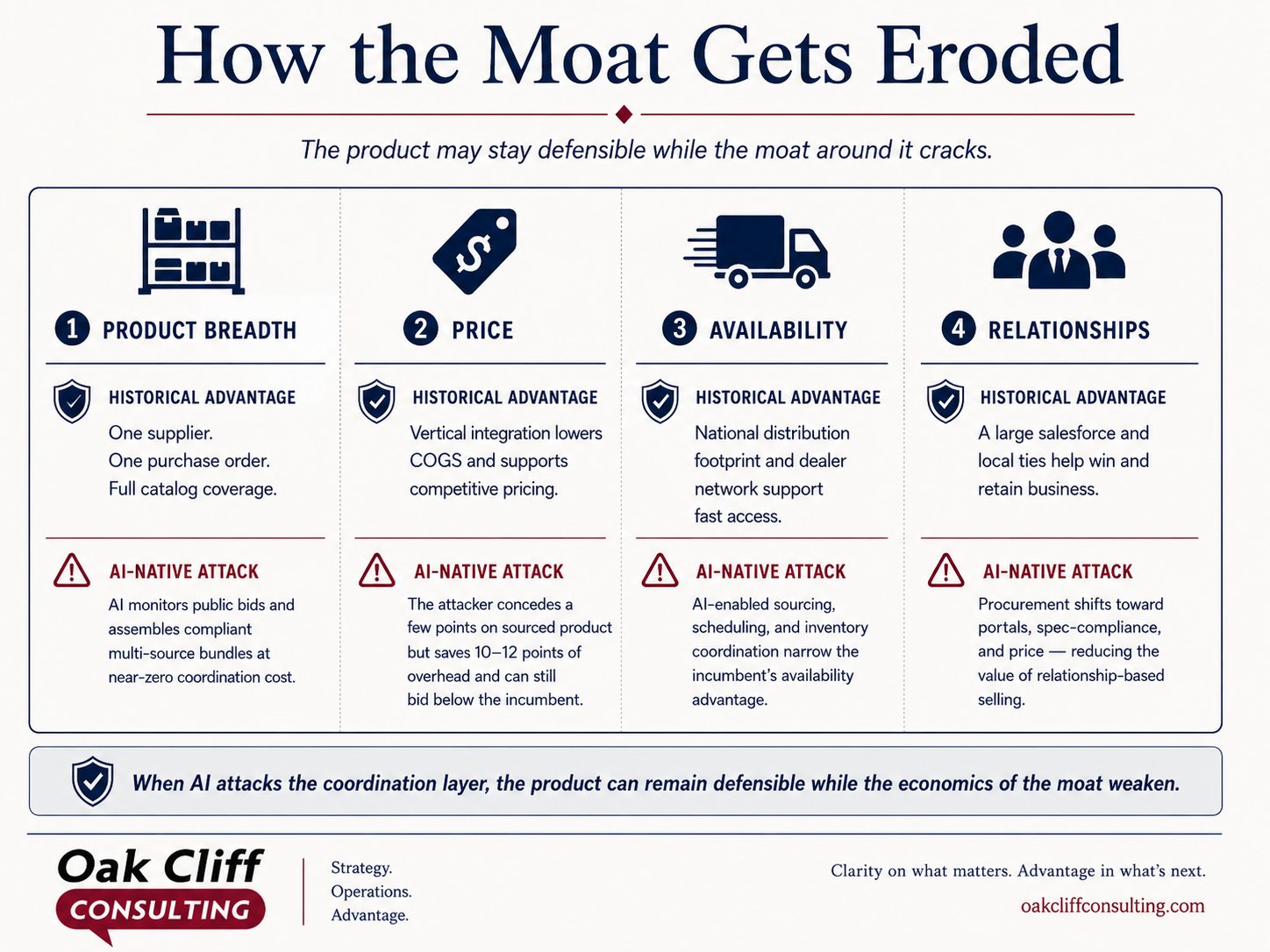
Product breadth: A coordination problem for human procurement at Valtir. However, State DOT bid boards sit public and machine-readable; an AI-native operator monitors every letting in the country at near-zero cost and assembles a compliant, multi-source bill of materials as easily as Valtir assembles a single-source one.
Price: A function of overhead. Valtir has lower COGS through vertical integration but carries 20 points of SG&A to manage it. The attacker concedes 3–4 points on OEM-sourced product and saves 10–12 on overhead. In sealed-bid procurement, delivered price rules — and an entrant bidding 5–8 points below Valtir while holding margin. The price ceiling is not set by the new entrant.
- Product breadth: A coordination problem for human procurement at Valtir. State DOT bid boards sit public and machine-readable; an AI-native operator can monitor every letting and assemble a compliant, multi-source bill of materials at near-zero marginal cost.
- Price: A function of overhead. The attacker can concede several points on OEM-sourced product while saving more on SG&A, allowing it to bid below the incumbent and still hold margin.
- Relationships: Customer procurement keeps migrating toward portals and spec-compliance workflows designed to reduce relationship purchasing. How much loyalty merely reflects the historical absence of an alternative?
Relationships: Often the most expensive and valuable part of commercial services. However, customer procurement keeps migrating toward portals and spec-compliance workflows designed precisely to eliminate relationship purchasing. How much of your "loyalty" merely reflects the historical absence of an alternative?
If the AI-native model succeeds in commercial services, the entrant drives down prices, likely forcing regional incumbents to sell for a fraction of today's value. National players gradually lose scale. Industry re-pricing begins.
The full case requires three beliefs to hold:
AI-native operators run a services back office 30–50% cheaper.
OEM sourcing replicates breadth faster than incumbents cut overhead.
Buyer behavior keeps shifting toward spec-and-price and away from relationships — a trend predating AI by a decade.
Hemingway's line comes to mind: "How did you go bankrupt?" "Two ways. Gradually, then suddenly."
The full case requires three beliefs to hold:
- AI-native operators run a services back office 30–50% cheaper.
- OEM sourcing replicates breadth faster than incumbents cut overhead.
- Buyer behavior keeps shifting toward spec-and-price and away from relationships—a trend predating AI by a decade.
Defending Your Strategic Moat
While we won’t speculate on the timing or size of the re-price, if you are in the commercial products and services space you are likely sitting in ‘your moment’. A moment in time when you have 24-36 months to revise how you operate and transform. In our last article we introduced the concept of ‘operating model debt’, or the unaddressed break points in how you work to translate your strategy into execution. In most organizations, commercial services and otherwise, operating model debt appears in 4 primary areas:
Data
Can the organization agree on the right data for the right decision? Are operational KPIs consistently defined and tracked?
Process
Are cross-functional handoffs clear, documented, and repeatable—or does institutional knowledge hold the operating model together?
Middle Management
Can middle managers carry a transformation? CRM compliance and operational KPI performance often reveal the answer quickly.
Governance
Do executive and Board meetings drive decisions, or become unstructured random walks caused by broken data, processes, and cadence?
Data: Debt accumulated here typically forms by incomplete integrations and migrations, introduction of numerous 3rd party platforms that serve one functional but not the whole, and consistent use of unstructured data for decision-making. Signs that you have significant debt here are that you struggle to either align on the ‘right data for the right decision’, or do not have a consistent way to track your operational KPIs.
Process: Are cross-functional hand-offs clear? Organizations work well functionally and breakdown cross-functionally. In the commercial products and services space, the most inconsistent hand-off is typically invoicing. Change orders and approvals may not be documented or clear, price may be unclear due to negotiated discounts off list price or regional pricing models, and customers often require invoicing through different systems. The more ‘institutional knowledge’ is required to run your business, the more ‘debt’ you have to work through.
Middle Management: The middle manager is the ‘secret sauce’ to every organization. They often have 10+ years experience, are trusted culture carriers, and, when things break, they know what to do to fix it. However, are they able to drive a change program? What has been your track record of prior change programs? The practical question we have learned to ask in commercial services is ‘what is your CRM compliance?’ Typically this is a gauge of how well middle managers can drive transformation. You can ask other questions as well about operational KPI performance, and you learn this quickly.
Governance: The accumulation of your debt often shows up in governance. Executive meetings and Board meetings are often unstructured ‘random walks’. The culture of ‘random walks’ then translate to team meetings. Often these random walks are the byproduct of broken data and processes resulting in unclear agendas. Just as common though is that the necessary meetings are not on the books. For example, the lack of a QBR, or a missing meeting between sales, market, supply chain, and delivery.
To be successful at an AI transformation, you will need to address the 4 steps above. As a reminder, the attacker carries no such debt — no legacy comp plan, no branch P&L to protect, no installed workflow with an owner two doors from the CEO. The incumbent must transform an organization; the entrant merely builds one with AI in mind from the start.
Defining Success
When it comes to AI usage, clients typically bucket into one of three categories:
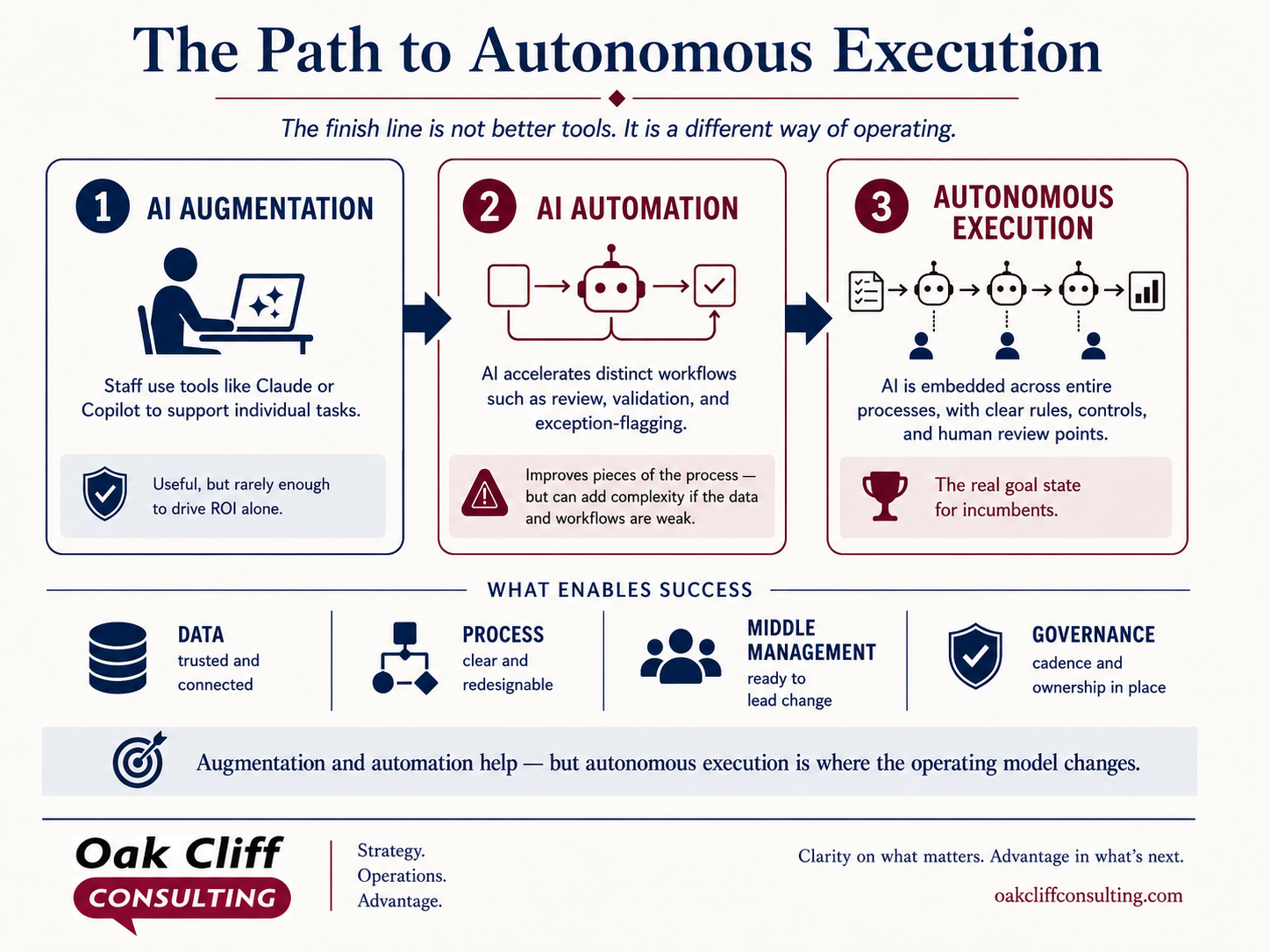
AI Augmentation
Staff are supported by AI tools such as Claude or Copilot.
AI Automation
AI is embedded within selected workflows to accelerate reviews and flag exceptions.
Autonomous Execution
AI is embedded across full processes, with human review checkpoints explicitly designed.
The Acid Test
Can an LLM create 80% of what is needed for an effective QBR with minimal human intervention?
AI Augmentation: Staff are supported by AI tools (e.g., Claude, CoPilot)
AI Automation: Previous workflows have AI embedded to accelerate reviews (e.g., a ‘bot’ that assesses final invoice from original invoice and flags adjustments for review)
Autonomous Execution: AI is embedded in entire processes, and human review check-points are well described (e.g., multiple ‘bots’ triage invoice adjustments, and final invoice with corrections is presented for human review)
The goalline for incumbent organizations is Autonomous Execution. We have yet to see a case-study that AI Augmentation and AI Automation on their own return a ROI. We do have plenty of anecdotal evidence, however, that AI Augmentation alone creates confusion for the frontline around what the future is, and AI automation of distinct workflows creates longer-term confusion when the data is not organized or updated at a regular cadence. In other words, there is evidence that when Augmentation and Automation are considered ‘the finish line’, you have added to your operating model debt rather than subtracting from it.
For all of our clients, we encourage them to start on their journey towards Autonomous Execution by creating an AI management system that sits on top of all of their data. For a demonstration of what this looks like: click here.
In creating the AI management system, you will be forced to deal with your data. Additionally, once you have the AI management system in place, you can build ‘agents’ to work from the management system. This ensures that every ‘bot’ is pulling data from a consistent place, and rules for data usages are set centrally versus functionally. Depending on your data structure, the creation of an AI system can be weeks to months – the longer duration of the work, the more valuable the investment because you are ‘catching up’.
A good acid-test question: Can an LLM create 80% of what is needed for an effective QBR with minimal human intervention? If the answer to that is yes, then you are on your way to success.
Is your operating model ready for autonomous execution?
Tell us where your moat, cost structure, or operating model feels most exposed. We will give you a direct answer.
Ask Oak CliffBoard Discussion Questions for Commercial Services Owners
Our conclusion: AI will accelerate the repricing of every industry and business model -- eventually. There will be a fundamental exposure to whether your operating model can support ‘autonomous execution’. Winning will be based on either doing the hard work of redesign, or AI-native companies that gradually build share and acquire failing incumbents. Whether this is 24 months+ away, or 10 years, is beyond the scope of this article.
Thank you for reading. We would like you to consider these discussion questions for your Board and Executive Table:
Which of our moat pillars survives a competitor running at one-third of our SG&A — and which merely charged a convenience premium to a vanishing procurement process?
What share of our FTEs touch the product versus the paperwork — and what automation exposure sits on the second group?
If an AI-native platform replicated our breadth through OEM sourcing within 24 months, which customers leave first — and what price concessions keep the rest?
How much of our customer "loyalty" merely reflects the absence of an alternative?
Will our hold-period plan fund a redesign, or harvest the moat — and what price tag sits on deferral?
Moat Durability
Which moat pillars survive a competitor running at one-third of our SG&A—and which merely charge a convenience premium to a vanishing procurement process?
Automation Exposure
What share of our FTEs touch the product versus the paperwork—and what automation exposure sits on the second group?
Customer Flight
If an AI-native platform replicated our breadth through OEM sourcing within 24 months, which customers leave first—and what price concessions keep the rest?
Customer Loyalty
How much of our customer loyalty merely reflects the absence of an alternative?
Hold-Period Choice
Will our hold-period plan fund a redesign, or harvest the moat—and what price tag sits on deferral?
About Oak Cliff Consulting
Oak Cliff Consulting launched in 2026 through a partnership of former middle-market executives and former members of Bain's leadership team. Our partners served as CEOs, CGOs, and CIOs, and clients worldwide trust us as advisors and counselors.
Enjoying the series? Join our growing community at oakcliffconsulting.com/sign-up for full access to our perspectives. We also offer consultation, and a Fractional AI Transformation Office composed of an executive and AI engineers.
