

Two announcements landed within the same fortnight that deserve far more attention than they received.
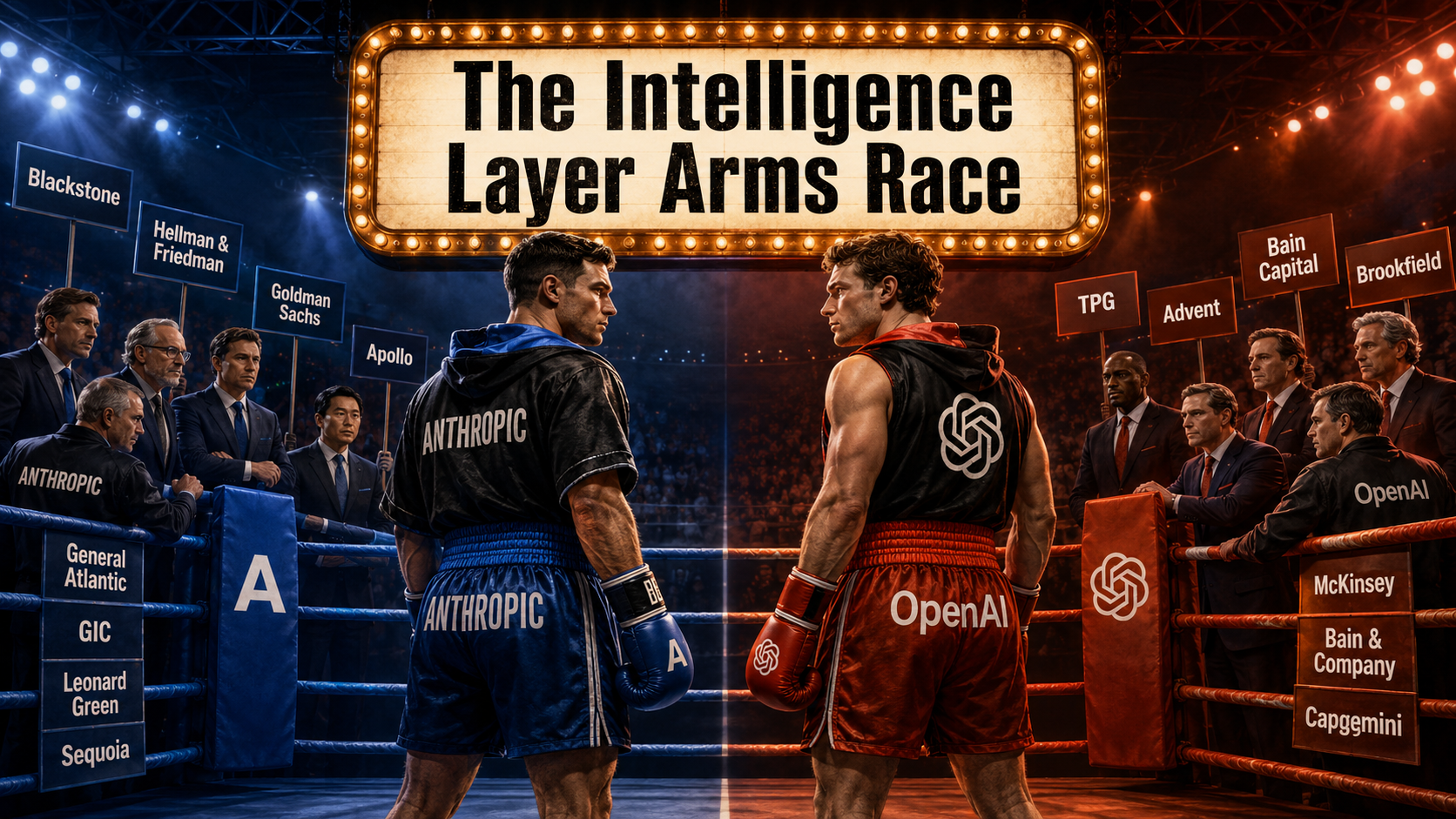
Anthropic partnered with Blackstone, Hellman & Friedman, Goldman Sachs, Apollo Global Management, General Atlantic, GIC, Leonard Green, and Sequoia Capital to launch a $1.5 billion entity purpose-built to accelerate Claude's deployment across hundreds of companies. One week later, OpenAI unveiled the OpenAI Deployment Company — a $4 billion joint venture seeded by 19 global firms, led by TPG, with Advent, Bain Capital, and Brookfield as co-lead founding partners. McKinsey, Bain & Company, and Capgemini appear to sit inside the cap table as well.
Both ventures embed engineers directly into client companies. Both target a wide part of the market.
For Board members and executives reading this: the Fortune 100 and the portfolio companies of these investors will likely face little genuine optionality here. Some will say no on security or regulatory grounds. Others will find the answer already decided ‘yes’ for them due to pre-existing relationships with the founding members of the JVs. For the remainder of the market — meaning most of you — a real choice sits in front of you, one carrying simultaneous potential for expanded strategic moat and EBITDA growth, and genuine risk of management distraction, EBITDA degradation, and employee alienation.
In the article below we will unpack industry parallels to understand why Anthropic and OpenAI each stood up a multi-billion-dollar venture to embed their AI directly inside your company. $5.5 billion in committed capital.
In addition, we will look at the complexity added by the firms that built franchises on disinterested counsel -- Bain, McKinsey -- now financial bedfellows with the LLM giants in their roll-out.
95% of enterprise AI pilots fail before they ever touch the P&L. The average initiative returns 5.9% only after 24 months. Any board applying a normal hurdle rate would reject the business case prima facie. And, furthermore, counsel is potentially conflicted.
And yet — we advise every client to invest in AI because of the compounding penalty that we expect will come to those that wait. The only quote we could find to summarize the moment: "The absurd is the essential concept and the first truth." – Albert Camus
In the conclusion of the article, we will summarize the situation with a practical path forward for how to drive your board discussion.
The Complicated ROI Picture
No clear body of evidence supports the premise that AI transformations, in aggregate, produce positive ROI — let alone ROI above any reasonable project hurdle rate. IBM's Institute for Business Value measured enterprise-wide AI initiatives at an average return of 5.9%. Deloitte found that when ROI materializes at all, the payback period typically exceeds 24 months. Gartner estimates that 85% of all AI models and projects fail outright. MIT found that 95% of enterprise AI pilots collapse before delivering measurable financial returns — implying that whatever aggregate return exists concentrates almost entirely in a thin stratum of exceptional outliers.
In any normal capital allocation environment, a reasonable fiduciary would prima facie reject an offering with an 85–95% abandonment rate and a sub-6% average return, especially when the timeline to even that modest return stretches past two years. And yet — to borrow Lincoln's phrase — the dogmas of the quiet past are inadequate to the stormy present.
This moment qualifies as unusual enough that the operative question for boards shifts. Not should we invest, but how much, where, and through what structure. At Oak Cliff, we broadly encourage our clients to make AI investments. Why?
The downside of inaction carries its own risk — one that compounds quietly until it doesn't. The decision made in the next few months will shape the next three to five years of your financial trajectory.
The Uniqueness of the OpenAI and Anthropic Partnership JVs
Pause on the OpenAI number. A $4 billion investment in a services joint venture. Capital commitments of this magnitude typically belong in hard assets — energy infrastructure, semiconductors, real estate. In the services industry, this figure lands without precedent. Stranger still, OpenAI reportedly guaranteed those backers ~17.5% annual return across five years. A frontier-model developer writing what amounts to a quasi-fixed-income coupon to secure enterprise distribution signals how strategically the players now price the commercial channel.
Why is the commercial channel so important right now?
The explanation traces back to structural questions: how many competitors can the "Intelligence Layer" market reasonably sustain? And will the “intelligence” of the model be the longer-term strategic differentiator – or, just as likely, the route-to-market or safety / risk / compliance (e.g. open v. closed-ended models)?
At Oak Cliff, we define the “Intelligence Layer” as the cohort of companies building large language models that convert massive compute infrastructure into reusable cognitive services — Anthropic, OpenAI, xAI, and Google Gemini in the US context, with Mistral and DeepSeek lurking at the international periphery. Microsoft – with a very different ‘route-to-market’ and product - also materially “lurks”. Unlike the other competitors in this space, Microsoft has the significant advantage of a massive installed base operating in an already approved security infrastructure.
So there are a number of players….. however, imagine for a minute that the market converges on a single dominant model — some "super-superhuman" intelligence that renders differentiation moot — what justifies more than one survivor? Markets that commoditize tend toward utility-grade regulation and razor-thin margins. Something called an "intelligence layer" becoming a commodity carries its own dark irony.
Alternatively, meaningful product differentiation might sustain three or four viable players. Maybe more. Both trajectories remain plausible; neither seems inevitable. It is unknown.
What is known: capital intensity (CapEx Spend divided by Revenue) in this industry currently runs above 50%.. The commonly held view among insiders holds that it will normalize above 20% at scale, even after training costs eventually moderate. Whether capital requirements begin declining in three years or ten sits firmly in the category of informed speculation. A closely held belief in certain circles suggests that models will eventually improve autonomously — reducing the need for continual training and compressing capital intensity toward maintenance levels. The implications of a self-improving model compound quickly from there, and this article will stop short of that rabbit hole.
To understand what is occurring in the emerging “Intelligence Layer” of the market, we will draw a structural parallel: the wireless industry.
Twenty years ago, a mentor's teachings have proved durable: scale drives profitability in capital-intensive industries. Wireless demonstrated this with clinical precision over two decades. Capital intensity held stubbornly between 15–20% of revenue across generational cycles from 2G through 5G. The absolute dollar commitments never stabilized — they grew proportionally with revenue. And the number of players the industry could sustain shrank with each generational upgrade. 2G supported five. 3G four. 4G three. 5G two? Nextel and Sprint are gone. In today’s 5G, AT&T, Verizon, and T-Mobile remain, but AT&T's wireless mobility margins compressed from the mid-to-high 50s to the low 40s over the last decade. The government almost certainly prevents a two-player wireless market from fully clearing — but the competitive logic is running as predicted by the maxim.
The Intelligence Layer appears to replicate this dynamic at a dramatically accelerated pace, and on a steeper capital curve. Subscriber scale and inference volume directly underwrite the capital structure. More usage means more revenue, which means more capacity to fund continued model development and infrastructure. Current estimates suggest Anthropic commands the vast majority of business customers; OpenAI holds the vast majority of retail consumers. The business sector dwarfs retail by current revenue and future opportunity. OpenAI needs to close a structural gap — and closing structural gaps in capital-intensive industries demands capital at scale, deployed early, before switching costs calcify.
Which brings us to switching costs within an enterprise. Once an enterprise builds products, workflows, and agent architectures around a given model, migration carries real friction. The more deeply embedded the model, the higher the switching cost. OpenAI's $4 billion bet reflects a specific thesis: lock in enterprise relationships now, while the Intelligence Layer remains fluid, before the market settles into patterns that favor incumbents — in this case, Anthropic's incumbency in enterprise.
The Fascinating Conflict-of-Interest Dynamic
Against this backdrop, you will shortly receive a visit from embedded engineers, earnest decks, and carefully constructed ROI projections.
Two dynamics deserve explicit acknowledgment before that meeting happens.
First, the language of this space remains inaccessible in ways that look accessible. Is it reasonable that an Executive group larger than 2 or 3 will be able to hold a fluent conversation about "agents," "tokens," and "inference"? Is it possible to converse effectively without everyone possessing the conceptual foundation to evaluate trade-offs between open and closed models, anticipate future token costs, or understand how radically different token consumption patterns appear across model families? A genuine Rosetta Stone for enterprise AI economics almost certainly cannot exist until frontier model development stabilizes — and that end-date remains unknown even to insiders.
Second, the historically neutral advisory firms no longer occupy neutral ground. Bain & Company, McKinsey, and Boston Consulting Group — all of whom built franchises on disinterested strategic counsel — now carry financial stakes in the outcome of the Intelligence Layer. The Bain of fifteen years ago that we at Oak Cliff started at never pushed a third-party product this aggressively. But the Bain of fifteen years ago did not face the prospect of its analyst-monetization model being structurally disrupted. First- and second-year analysts represent a significant portion of consulting economics; an AI that can replicate that work attacks the cost structure of the business model itself. Can you blame the Bain, McK, and BCG strategic layer for creating these partnerships? At Oak Cliff, we do not. However, we do differently scrutinize their thinking for bias. The incentive to encourage client AI adoption — and to steer that adoption toward a specific partner — warrants scrutiny.
If a World Cup player’s Nike-sponsored coach declares Nike objectively superior to Adidas, a reasonable athlete seeks a second opinion.
The AI Discussion at the Board Level
Legacy prioritization frameworks built on IRR and NPV will steer you away from AI investment — the data underwrites that conclusion. But we established already that these times resist the ordinary playbook, and the old frameworks no longer bind.
When we interview board members about why they invest in AI today, one pattern surfaces repeatedly: they invest to defend strategic moats they already hold. The ROI on a downside-risk scenario reflects, in the end, whatever you choose to believe — a species of intellectual honesty that group decision-making rarely renders explicit.
We encourage boards to stage the AI discussion across four dimensions.
Current course and trajectory
Set market and competitor context aside for a moment and look strictly inward. Does the organization track toward its expected return within the intended hold period? If the answer reads “yes,” or even “maybe,” your AI program should shrink dramatically. AI returns scatter unevenly; no prudent operator wants bankable AI gains load-bearing for the EBITDA plan.
We suspect, though, that most organizations — privately held ones especially — will answer “no.” Private equity in particular no longer leans on financial engineering; operating performance now carries the return. Bain’s latest mid-year review pegs the EBITDA growth required for value creation at 10–12% annually. Layer that onto the softening across core PE sectors, and the honest answer for most readers settles at “no.”
Sizing the bet
A spectrum runs between full embedded deployment and inaction, and your position on it follows, first, from your trajectory.
Organizations that answer “yes” or “maybe” should not read this as license to sit still. Far from it. We advocate a measured posture: simplify the tech stack, redesign the cross-functional hand-offs, cultivate AI fluency as an organizational capability, and land one or two genuine use-cases. Is our organization making disciplined investments that strengthen the business today while creating a credible future AI value creation story? A privately held company earns, through that work, a credible AI narrative about the value its next owner can unlock. A public company positions itself for a smoother transition three to five years out, when bankable returns finally matter — and the prework, done well, makes those returns far easier to capture.
Organizations that answer “no” should weigh the larger bet. Given our current trajectory, should we make bolder, AI-enabled transformation bets to materially improve the company’s competitive advantage and enterprise value? Are we underestimating the opportunity to use AI as a catalyst to reinvent how our business operates? A rare opening sits in front of these executives: leapfrog the competition and dig a deeper moat. We noted already that most AI business cases, stated or not, rest on downside-risk scenarios. When the base case already looks ugly, the argument that AI delivers only upside grows far more honest.
A subtler point hides underneath. Set AI aside entirely. Organizations off their needed course tend to run broken operating models — the machinery by which a company makes and executes decisions, spanning internal capability, structural design, and the supporting tech stack, sits in disrepair. As a principle, more value leaks from effective strategic execution than from what the strategy contains. These organizations need an operating-model transformation whether or not AI ever enters the room. And AI adoption amounts, fundamentally, to an operating-model transformation. AI therefore lets you run that overhaul on steroids. Swing big!
The industry and competitive context
By now you hold a provisional answer. Pause on it. Now ask these questions:
- How exposed does your industry sit to AI-native disruption? Does the underlying market forecast itself break once AI reprices the category?
- How do your nearest peers posture — and does anything in their stance argue for moving harder, or softer, than your inward read suggested? If a competitor were to successfully deploy AI before us, where are we most vulnerable?
Pressure-test ambition against the external picture. Does the answer survive contact with the market and the competition, or does it shift?
Empowering your team
Our next article will dig into what breaks inside organizations chasing AI transformation — what an operating model actually comprises, and how it must evolve to carry AI. For the board, though, one question presses now: what resources will we muster to reach the AI goal? Do we have the leadership, resources, and accountability required to turn our ambition into measurable business outcomes? A few foundational principles frame that conversation.
First, the field barely predates today’s college seniors — ChatGPT launched the autumn they started as freshmen. So the talent across the deployment layer runs thin at every level. Anyone marketing themselves as a “grey-haired” AI expert merits the same suspicion you would extend to any other snake-oil pitch.
Second, value extraction from AI demands behavioral change, and behavioral change resists almost everything. Moving people to act constitutes a genuine skill — and the people who understand the technology most deeply rarely overlap with the people who can shift human and organizational behavior.
Third, as we have already established, there is an uncomfortable conflict-of-interest among the historically dispassionate strategic advisors. Any firm arriving with a disclosed AI partnership warrants a concurrent, independent read on AI strategy. Against the capital at stake, a second opinion costs almost nothing.
Stack those three realities — no genuine experts exist, the sharpest technical minds rarely carry the gift for moving people, and the advisors you long trusted now hold a stake in your answer — and the question writes itself: where does a board turn? We offer two pieces of hard-won counsel.
First, the CEO must own both AI vision and the change outright. Organizations function well within silos and fracture across them, and AI transformation, almost by definition, runs cross-functionally. No one below the CEO commands the entire org chart, so no one below the CEO can lead it.
Second, the CEO needs a co-executive to carry the vision through execution. A chief executive's existing staff rarely holds the slack to absorb a full-scale transformation atop the day job, and the consulting literature — Bain and McKinsey included — names under-resourcing among the leading causes of transformation failure. Ideally, you stand up a new Chief AI Transformation Office – either fractionally or full-time- led by someone steeped in change management and operating-model design, commanding a bench of AI engineers — drawn from the two partnerships just announced, or from the plethora of firms now crowding this budding field — to build the products success demands.
Need an independent read on your AI strategy?
Tell us what your Board or executive team is working through. We will give you a direct answer.
Ask Oak CliffIn Conclusion: The TL;DR
Two partnerships, $5.5 billion between them, just opened a competitive window — and the capital committed signals it will close. The aggregate data on AI ROI looks dismal: sub-6% average returns, 85–95% abandonment, payback past two years. In ordinary times a fiduciary rejects that offering outright. These times overrule IRR and NPV, so the question shifts from whether to invest to how much, and through what structure.
Calibrate to your own trajectory first. On course to your return? Prepare quietly — simplify the stack, build fluency, bank a use-case or two — and resist letting AI gains carry the EBITDA plan. Off course? Swing big; when the base case already looks ugly, AI reads as pure upside, and the operating-model overhaul you needed anyway runs faster with it. Then pressure-test that answer against your industry's exposure and your peers' posture before you commit.
Whatever the size of the bet, reckon honestly with how agents fail — at a scale and severity no person matches — and resource the effort to match the ambition. No true experts exist yet, the best engineers rarely move people, and your once-neutral advisors now hold a stake in your answer; buy an independent second opinion, put the CEO in command, and stand up a Chief AI Transformation Office under a leader who knows change and operating-model design. The window closes either way. The only variable within your control: the quality of the question you bring to it.
Summary Board Discussion Questions
Trajectory
Are we on track to our expected return within the hold period?
Value Creation
Are today's investments strengthening the business now and building a credible AI value-creation story?
Ambition
Should we be making bolder, AI-enabled bets — and are we underestimating AI as a catalyst to reinvent how we operate?
Industry Exposure
How exposed is our industry to AI-native disruption? Does the market forecast itself break once AI reprices the category?
Competitive Risk
How do our peers posture — and where are we most vulnerable if a competitor deploys AI first?
Execution Capacity
Do we have the leadership, resources, and accountability to turn ambition into measurable outcomes?
About Oak Cliff Consulting
Preview of the next article: During our next installment we will explore our perspective on why AI transformations fail, where Boards and Executives settle for negative or dilutive value, and how to avoid these common traps. As a teaser, the failure point has not been (and will likely never be) failure to engineer the right product. It has been the failure to understand the complexities of the operating model, the failure to read operating model and tech debt in parallel, and the failure to empower change with a bold executive vision — owned at the top, then driven from the middle of the organization out.
Sign-up: Like what you are reading? Please join our growing community to have access to all our perspectives. We are also available for consultation, and offer a “Fractional AI Transformation Office” composed of an executive and AI engineers.
