
“In preparing for battle I have always found that plans are useless, but planning is indispensable.” — Dwight D. Eisenhower
This is the fourth and final installment in our series on AI transformation. A quick recap:
Article #1: Mapped the $5.5 billion collision between the Anthropic and OpenAI deployment ventures and offered a rubric for scoping your board's ambition.
Article #2: Used Jack Dorsey's cut-first decision at Block to introduce “operating model debt” — the unaddressed decision rights and workflows that stall AI's return.
Article #3: Used an example company (Valtir) to stress test how an AI-native competitor could challenge their business and lead to broad repricing in Commercial Products & Services.
Today's article summarizes the call to action and lays out a workplan for running your own AI transformation.
The Call to Action: “12 Is the New 5”
A deal that only needed 5% annual EBITDA growth to clear a 2.5x return during the 2010s now needs something closer to 10–12%. The tailwinds that used to do that work are gone:
Borrowing costs sit at 8–9%, up from a lower-rate decade.
Leverage has fallen from roughly half the capital structure to a third or less.
Multiples remain near record highs for now — mostly because low deal volume has investors sitting on assets rather than taking losses.
How achievable is 10-12% annual returns through the life of a hold?
Bain's longitudinal research on “Sustained Value Creators” — companies that grow revenue and earnings faster than inflation while earning back their cost of capital — puts that group at roughly one in ten. A select few operators will sustain double-digit EBITDA growth. Most will not.
Are you a top-10% operator? We believe if you're reading this article, you already are — or will be. A transformative leader's principal barrier is not capability. It's conviction.
And you likely don't get to opt out. AI-native entrants are already assembling the cost structure to come for your share. Industry repricing risk is real.
The Confusing Landscape in AI Transformation
New tools launch faster than any procurement process can vet them. Frontier models update on a cadence that turns a carefully built prompt library or agent workflow into legacy architecture within a quarter. Security and data-governance protocols that felt sufficient six months ago now look thin. The leaderboard of “winning” vendors and models reshuffles often enough that placing a bet feels like placing it on sand.
Amid this landscape, every organization's AI effort sits on one of three rungs:
AI Augmentation: staff are supported by AI tools — a person still does the work, with help.
AI Automation: AI is embedded in an existing workflow to accelerate review — a bot flags something for a human to check.
Autonomous Execution: AI runs entire processes end to end, with human checkpoints clearly defined.
The goal line for incumbents is Autonomous Execution.
Augmentation and Automation are waypoints, not destinations — useful for building fluency, but neither returns an ROI on its own. As we've repeated throughout this series: don't worry about the engineering, don't fall in love with the tool, stay ruthlessly focused on the business outcome.
A concrete picture of Autonomous Execution: a distributor's rebate-claims process where intake, matching against contract terms, and payout all run without a person touching the queue — a human reviews only the exceptions the system flags, not the whole pipeline. That's the difference between a bot that helps someone process claims faster and a process that no longer needs a person in the loop by default.
AI Augmentation
Staff are supported by AI tools. A person still does the work, with help.
AI Automation
AI is embedded in an existing workflow to accelerate review and flag exceptions.
Autonomous Execution
AI runs entire processes end to end, with human checkpoints clearly defined.
The Goal Line
Augmentation and automation are waypoints. The destination is autonomous execution tied to a business outcome.
What a Transformation Must Have
1. Transformation needs a clear North Star
People can tolerate uncertainty, but they cannot align around ambiguity. The organization needs a simple, shared view of where it is going, why the change matters, and what will be different when it succeeds. The North Star needs measurable financial targets that are motivating and stretching, but also achievable.
In practice, a full-potential target looks like: a $300M distribution business cutting order-to-cash from eleven days to two, or a services firm moving quote turnaround from three days to same-hour — stated as a number the whole executive team can repeat, not a slogan about "leaning into AI."
2. Leadership must visibly own the vision
Leaders cannot delegate the case for change. They must:
Define it, and repeat it often
Make the tradeoffs it requires
Say out loud what others may be reluctant to acknowledge
Think campaign trail, not press release: consistently on message, and highly visible.
The data supports the instinct: McKinsey found transformations are 5.3x more likely to succeed when senior leaders visibly role-model the behaviors they're asking for, and twice as likely to succeed when leaders spend more than half their time on the effort — though only 43% of leaders actually do.
3. Real change must move middle-management out, not top-down
Middle managers translate strategy into daily behavior. Bypassing them may look faster, but it almost always weakens adoption. Instead:
Empower them as initiative leaders
Give them ‘step-up’ opportunities to present to senior teams
Run small-group listening sessions frequently
This is where most transformations actually die: Bain research published in HBR found that fewer than one in eight transformations produce lasting results under the conventional top-down model. A separate HBR study found most middle managers are willing to support change — they resist because they aren't given enough input into how it's designed.
4. Make as many decisions reversible as possible
Transformation slows when leaders treat every choice as permanent. Organizations need more two-way-door decisions: act, learn, adjust — and preserve escalation for the few choices that are genuinely hard to reverse.
Bain's decade-long study of more than 1,000 companies found a statistically significant link, at a 95% confidence level, between how effectively an organization makes decisions — including how fast — and its financial performance.
When we lead transformations, we leave every Steering Committee with an Exit Ticket: people vote 1–5 on how well the session adhered to the four principles above.
A low score means change course; a high score means keep going. Don't be afraid of low scores — “red is good” because you can course-correct. False greens are the enemy.
Where These Four Beliefs Get Skipped
In our experience, most failed transformations trace back to one of these four beliefs being ignored — not to a bad plan:
Tool-first thinking: chasing a vendor demo before the North Star exists (Belief 1)
Weak sponsorship: a CEO who announces the vision once and moves on (Belief 2)
No middle-management buy-in: redesign handed down as a finished org chart (Belief 3)
Too slow: SteerCo’s hold everything up. Energy is spent in the wrong spots. (Belief 4)
The Transformation
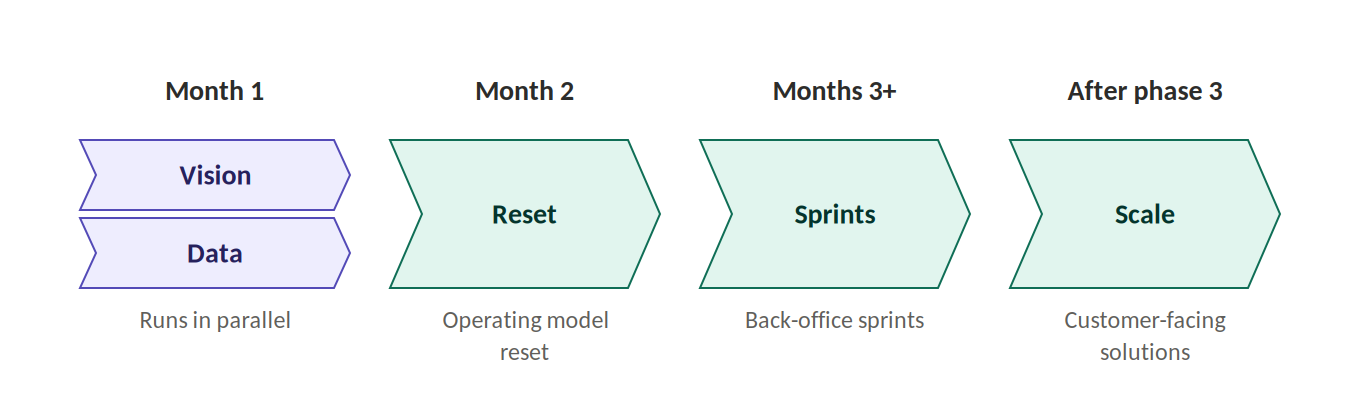
Below is the tactical sequencing for running an AI transformation, in-house or with outside support. The roadmap looks similar to a non-AI transformation, with differences in four key places:
The Roadmap
Phase 1: Foundation (Month 1)
Vision, data, and diagnostic work run together in parallel — not waterfall.
Resourcing for a $200M–$500M business or business unit:
Vision: ~1 person working with the executive team on the vision and full-potential benchmarks
Diagnostic: 1 additional person support organizational interviews on current roles, processes, and governance — time-consuming but high-value; advice is to stay tactical rather than auditing everything
Data: A team of ~2 — one engineer designing the future-state data container, another mapping where data lives today
Total: roughly 3-5 FTEs plus an engineer, working full-time on the transformation.
Phase 2: Operating Model Reset (Months 2–3)
This is the hardest work in the transformation — strategic, emotional, and detail-oriented.
Resourcing for a $200M–$500M business or business unit:
Org design: One person working with HR to redesign the org chart, rewrite job accountabilities, and build a support plan for the roles changing most
Process & governance: Two people handling process redesign, governance, and initiative scoping — including what future teams look like
Communications: The already listed members are building the communication and change-management plan together, though expect the CEO to be heavily involved in shaping its tone
Hold off on building most tools during this phase — it's about planning, and data-structure work will often bleed into Phase 2 regardless. The one exception: if your AI engineer is ahead of schedule, use that slack to design ‘no-regret’ solutions on the new data infrastructure — a Chief of Staff bot for email, a CRM bot for sales planning, a QBR/board-materials bot. These improve efficiency through augmentation, but don't expect a clean, measurable ROI from them yet.
Phase 2 also forces a key decision: which jobs to redesign now versus after proof of concept.
Phase 3: Back-Office Sprints
Avoid anything that directly touches the customer here — that’s the highest-risk work.
Start with back-office redesign instead: it builds momentum and limits downside if things break.
Two-week sprints against cost-saving and revenue-efficiency processes, each opening with problem mapping before solution scoping
A cross-functional team plus one embedded engineer per initiative — this talent is easy to source, so keep it on standby
Start slow and add initiatives gradually; don’t overload organizational energy
Track progress with weekly Red/Yellow/Green meetings at the executive level
Rank candidate sprints on three criteria:
Size of the cost or cycle-time impact,
Speed to validate against a clear baseline, and
How contained the downside is if it fails.
A first sprint might target invoice matching or vendor onboarding — high-volume, rules-based work with an existing cost baseline — before moving to anything judgment-heavy.
Phase 4: Customer-Facing Solutions
Only once the back end is stable does AI move to what a customer can feel — quotes, order status, service. Sprints stretch to two to four weeks, and the validation bar rises accordingly.
A representative first sprint here: an automated quote workflow that still routes any deal above a defined size or discount threshold to a human before it goes out — the customer feels the speed, and the exception path protects the relationship.
Need help sequencing the transformation?
Tell us where your organization is starting. We will help translate the playbook into a practical workplan.
Ask Oak CliffTeam Roles
An executive team with engaged middle managers can run this without hiring a program office, provided the roles are explicit from day one and supported by 3+ FTEs for coordination and cross-functional communication. Regardless of whether you hire from the outside for the program office, you should likely hire from the outside a contractor as an AI Transformation Leader.
The AI Transformation leader skill-set should be in change management and transformation – not AI tools and engineering.
Qualitative feedback from clients we talk to is that AI Transformations Leads that are AI engineers results in a focus on the technology over the PnL impact.
Why do we recommend an outsider for the AI Transformation Lead role? It brings:
Specialized expertise in change and transformation
A coach-and-player presence for teams that need it
Unbiased feedback to the executive team on how things are actually going
However, in prior transformations, we have minimized the need for extensive outside resources by creating “interim” positions: 6–9 month roles existing employees can apply for, with a job guarantee once the position ends. It's an effective way to pull high performers out of their function to help design the future state, if you're running this internally.
Beyond that, you'll need to augment with additional engineering resources — readily available through online marketplaces, and recent college graduates often have the right skill set.
Meeting Cadence
The Clock Is Already Running
Since 1970, average tenure on the S&P 500 has fallen from 33 years to 15. More than half the companies on the index in 2000 are gone. Every disappearance traced back to task automation or paradigm shift — never both at once, until now.
We believe this is one of those moments. You will see it first in the public markets, the way you always have — a familiar name quietly dropping off the index, a competitor’s earnings call explaining away another point of share loss. Private markets won’t offer that same visibility. There’s no index to fall off of, no ticker keeping score in real time. But the pain will be just as real: an EBITDA base that quietly stops compounding at the rate the model assumed, a repricing at exit that shows up nowhere until the term sheet does.
The decision in front of you is real, and so is the discomfort of making it without total certainty. We believe few executive teams should navigate it alone — not because the strategy is unclear, but because objectivity gets harder to hold onto the deeper you are inside your own transformation. That case is for a partner in the thinking, not just a plan on a slide.
Conclusion
Four articles, one throughline:
Part 1: The arms race reshaping the intelligence layer — two of the industry’s most valuable companies committing $5.5 billion on the bet that deployment matters as much as the model underneath it
Part 2: What actually stalls incumbents — not a lack of ambition, but operating model debt: the decision rights, workflows, and accountabilities nobody redesigned
Part 3: A price on that debt, using a business with none of software’s economics to show repricing risk reaches every incumbent, not just the ones selling SaaS
This article is what you do about all three.
The playbook above won't guarantee you land in the roughly one in ten companies that sustain double-digit growth. It will make sure operating model debt isn't the reason you don't. Eisenhower had it right at the top of this piece: the plan is worthless, the planning is not.
Executive Discussion Questions
Full Potential
Do we know, in specific and stretching terms, what “full potential” looks like for us — or are we still managing to last year's plan?
Sequence
Have we made the redesign-first-or-cut-first decision explicitly, or are we defaulting into one without saying so?
Leadership
Who is our AI Transformation Lead, and do they have the authority to make Phase 3 and 4 sprint decisions without a monthly committee in the way?
Customer Risk
Have we protected the customer by sequencing back-office work first — or are we chasing the biggest number on the board regardless of where the risk lands?
About Oak Cliff Consulting
Oak Cliff Consulting launched in 2026 through a partnership of former middle-market executives and former members of Bain's leadership team. Our partners served as CEOs, CGOs, and CIOs, and clients worldwide trust us as advisors and counselors.
Enjoying the series? Join our growing community at oakcliffconsulting.com/sign-up for full access to our perspectives. We also offer consultation, and a Fractional AI Transformation Office composed of an executive and AI engineers.
